ANU Payment Tracker
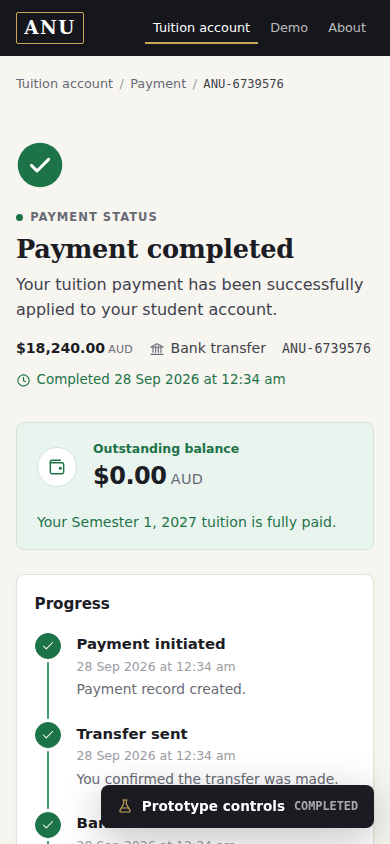
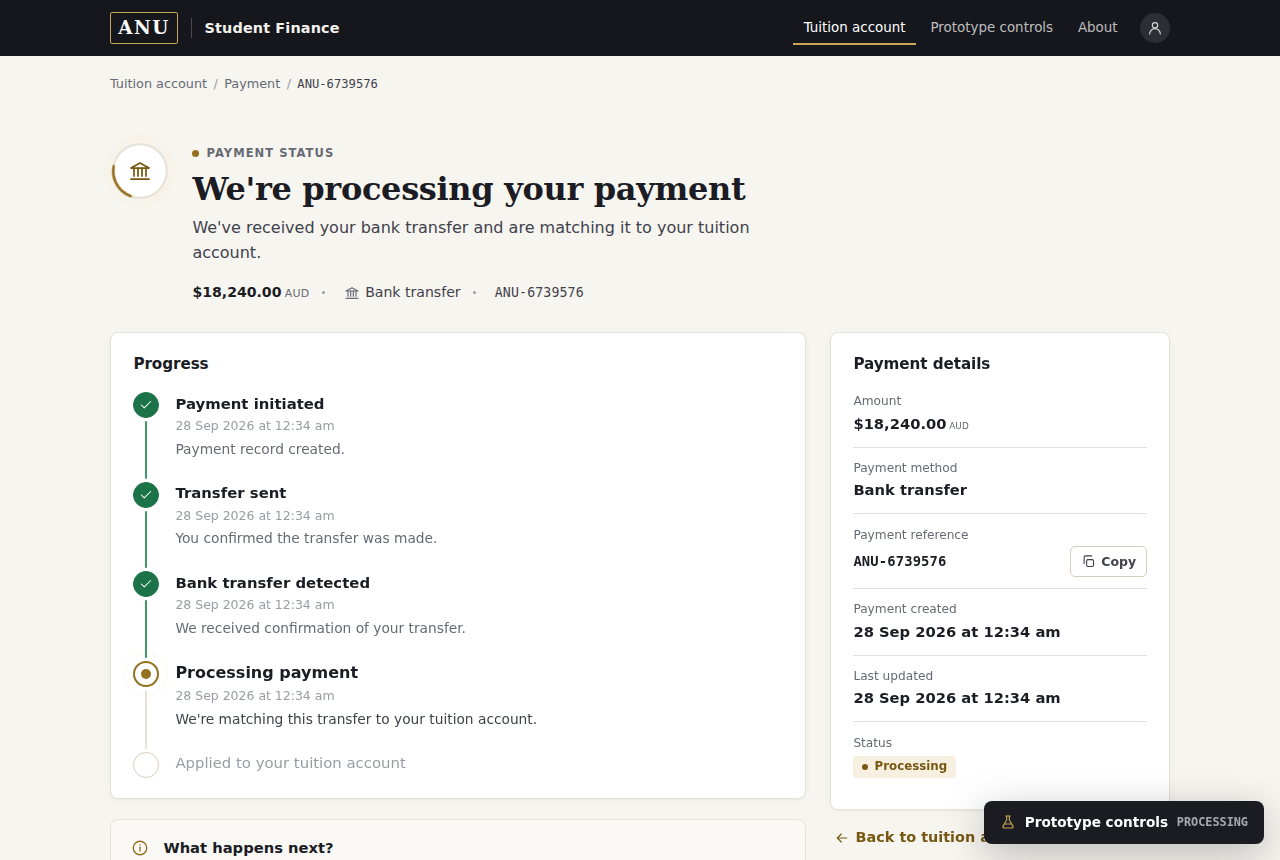
A prototype of the part of paying tuition that usually gets no design at all: the days between the money leaving your bank and your balance changing. You start a payment, get a real persisted payment reference, and then watch a tracker that answers the three questions a student actually has — where is my money, what happens next, and do I need to do anything? — until the payment is applied and the balance reads $0.00. It models one fictional student and processes no real money; a prototype-controls panel stands in for the bank and card events a real system would receive.
Try it
- Pay tuition → Bank transfer → I’ve made the transfer.
- Open Prototype controls (bottom right of the tracker, or
/demo/) and step through Simulate bank receipt → Start ANU processing → Complete payment. Each click writes to the database and returns you to the tracker, which animates the change. - Refresh at any point — the state is SQLite on the server, not the browser.
- Reset demo puts everything back to an unpaid account.
Try Simulate delay, or Card payment → Simulate declined card, for the exception states.
What good looks like here
Reducing uncertainty is the product. Every state is written to answer “where is it, what next, do I need to act”, with a timeline showing what has happened and what hasn’t, and a What happens next? panel that changes with the state. Delays and failures say plainly what they mean for your balance.
Trustworthy rather than impressive. I looked at how Wise, Apple Wallet’s transaction details, modern banking apps and good government service pages handle transaction status, for their hierarchy and restraint, not their look. The result is a warm neutral page, ANU-inspired gold used sparingly, and colour that always means something: green only once money is confirmed, amber for waiting too long, red only for failure. Motion is feedback: it plays when the status has actually changed since you last looked, never on a plain refresh, and not at all under reduced motion.
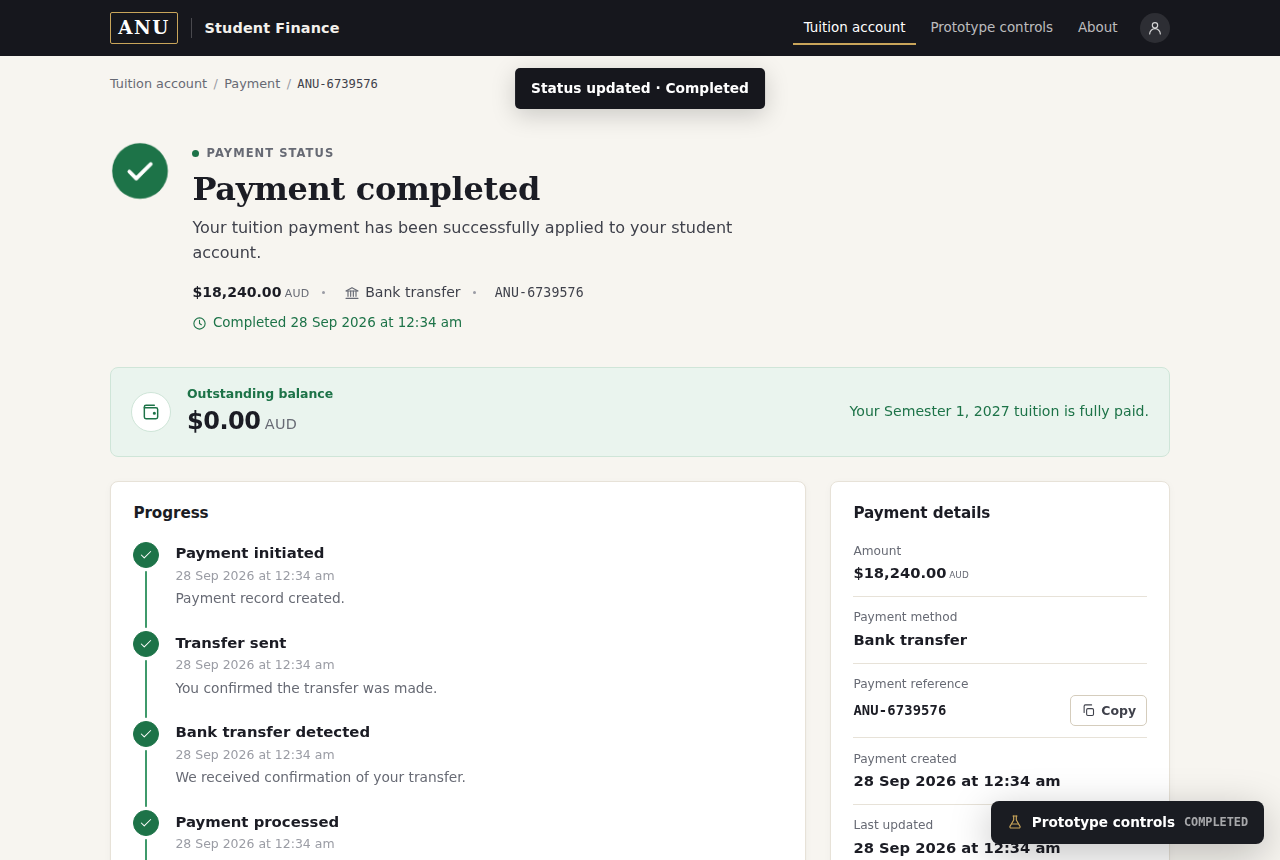
The server decides what can happen. Payment state moves only through one transition table, so an out-of-order step is refused (HTTP 409) rather than trusted from the browser. Money is stored as integer cents. An account has at most one payment in flight. Completing a payment and zeroing the balance happen in one transaction, so the two can never disagree.
What’s enforced, and what’s judgement. spec/payment-tracker.test.ts
drives a real bank transfer through the whole lifecycle over HTTP and checks it
survives a reload, that an illegal transition is rejected, and that reset
restores the account. spec/invariants.test.ts holds every page to an
accessibility floor, including zero axe-core violations. Whether it looks and
reads like a service you’d trust with $18,240 can’t be tested; that part is a
judgement call.
What I chose not to build
No real payment processing, bank integration or card entry. No sign-in or multiple students. No refunds, partial payments or payment plans. No email or push notifications. Each is real work in a real system, but none of them changes whether the tracker answers the student’s questions. They’d have taken time away from the part this prototype is arguing for.
How it’s built
Astro in server mode, Drizzle ORM and SQLite, deployed to a single Fly.io machine with the database on a volume. Migrations run at boot, and an empty database seeds the demo account itself, so a fresh volume (or the test harness) comes up working.